
MPF200TC-FCVG484E Datasheet: Full Specs & Performance Guide
Summary: This guide distills the device datasheet into a practical, deployable reference for engineering teams. Evidence: The MPF200TC-FCVG484E delivers roughly 192,000 logic elements in a 484-ball FBGA footprint with a mix of on-chip RAM, PLLs, and SERDES resources. Explanation: The following sections prioritize actionable specs, measurement methods, integration rules, timing techniques, and a pre-production checklist to accelerate evaluation and production readiness.
1 — MPF200TC-FCVG484E at a glance: package, density, and intended uses
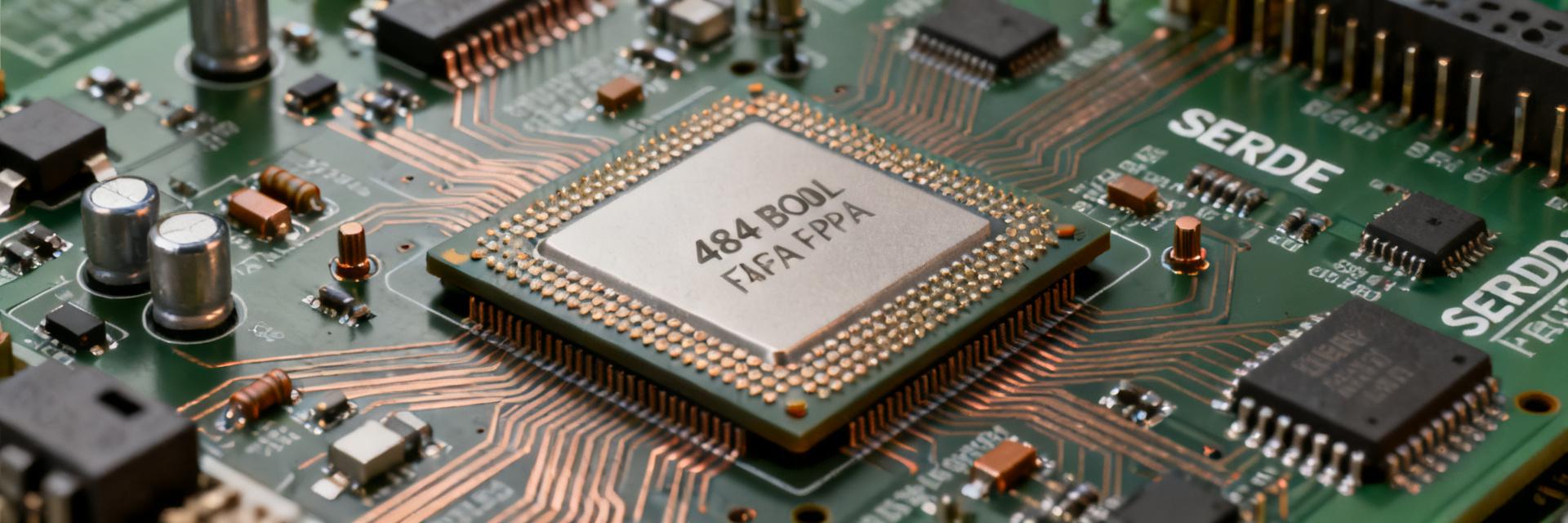
1.1 — Quick spec summary
Point: Capture headline specs in a compact format so system architects can size designs quickly. Evidence: Key specs include logic elements (~192K), core and I/O voltage domains, maximum I/O count, 484-ball BFBGA package, on-chip RAM and PLL/SERDES counts. Explanation: Below table and short notes let engineers map features to target applications such as mid-range wireline, access, and control-plane acceleration without vendor-specific assumptions.
| Parameter | Value |
|---|---|
| Logic elements | ~192,000 |
| Package | 484-ball FBGA |
| Core voltage | Typical 0.9–1.0 V class |
| I/O domains | Multi-rail: 1.2–3.3 V families |
| On-chip RAM / PLLs / SERDES | Moderate RAM, multiple PLLs, several SERDES lanes |
1.2 — How to read the official datasheet
Point: Prioritize sections that impact system-level decisions during early evaluation. Evidence: Start with top-line specs, then review electrical tables, mechanical drawings, thermal characteristics, and detailed timing tables. Explanation: A pragmatic read order is: summary table → electrical characteristics & recommended power rails → thermal and mechanical sections → timing and I/O tables; flag any limits that affect board stack-up, cooling, or power sequencing.
2 — Full electrical & mechanical specs breakdown
2.1 — Power rails, current consumption, and voltage domains
Point: Document every recommended voltage and sequencing rule before layout. Evidence: The datasheet lists recommended core and I/O voltages, static and dynamic current ranges, and sequencing notes; measure currents under defined configuration states. Explanation: When reporting measured values, include supply tolerance, ambient temperature, configuration bitstream state, and measured clock rate.
2.2 — I/O capabilities, package pinout & mechanical considerations
Point: Ensure I/O standards and mechanical constraints are aligned with system requirements. Evidence: Supported I/O families typically include differential standards like LVDS and a range of single-ended CMOS levels. Explanation: Extract ball assignments for high-speed lanes, confirm PCB land pattern and solder-mask openings early in board design.
3 — MPF200TC-FCVG484E performance benchmarks & thermal profile
3.1 — Benchmarking methodology & representative test cases
Point: Use standardized workloads to compare frequency, utilization, and power. Evidence: Benchmark cases should include high LUT/FF utilization DSP workloads, sustained memory bandwidth streams, and SERDES throughput tests. Explanation: Record metrics such as max stable clock for a target LUT utilization, bandwidth achieved per memory port, latency for key paths, and power per utilization point.
3.2 — Thermal behaviour and cooling recommendations
Point: Map electrical power into thermal budget and cooling strategy. Evidence: Use junction-to-ambient (θJA) guidance from the datasheet plus measured power under representative workloads to estimate delta-T. Explanation: For mid-range power levels, prefer a combination of low-profile heatsinks and directed airflow; validate with thermal profiling.
4 — Integration & Hardware Guide
4.1 — Power & Decoupling
Implement robust sequencing and local decoupling. Place bulk and high-frequency decoupling close to device pins, route power planes to minimize loop inductance.
4.2 — Clocking & PLLs
Clock integrity drives performance. Use low-jitter references, separate sensitive clock returns from noisy power domains.
5 — Timing Closure & Optimization
5.1 — Synthesis & Routing
Early constraints and floorplanning reduce iterations. Constrain clocks, use hierarchical constraints for blocks, and apply pipe-lining for long paths.
5.2 — Power vs Performance
Tune frequency and gating to minimize dynamic power. Techniques include clock gating and dynamic frequency scaling.
6 — Validation checklist & deployment steps
6.1 — Pre-production Validation
Follow a stepwise validation to reduce production surprises. Execute each item with pass/fail criteria and document test conditions before moving to pilot builds.
6.2 — Procurement & Lifecycle
Plan for supply and firmware lifecycle. Track device markings, Qualified Assemblies, and implement bitstream versioning and rollback capability.
Summary
This concise wrap-up directs teams to prioritize critical evaluation steps for the 192K-logic-element, 484-ball FBGA-class FPGA.
- Extract headline specs and package constraints early to size power and PCB layout.
- Run standardized benchmarks covering LUT/FF, memory, and SERDES while logging thermals.
- Apply recommended power sequencing; verify PLL lock and jitter under worst-case voltage.
- Use hierarchical constraints and floorplanning to reduce congestion and document trade-offs.
FAQ — Common engineering questions
What measurement conditions should be recorded when reporting device power and thermal data?
Record ambient temperature, board mounting orientation, airflow speed, supply tolerances, configuration state (bitstream and enabled peripherals), and clock rates. Include thermocouple locations for meaningful power characterization.
How should I prioritize datasheet tables during an early feasibility study?
Start with headline specs and recommended voltages, then review absolute maximum ratings, thermal resistance figures, and pin assignments. Follow with timing tables for critical interfaces and mechanical drawings.
What are pragmatic bench validation steps for high-speed SERDES links?
Verify reference clock integrity and PLL lock, run BER tests with PRBS patterns at target line rates, sweep temperature and supply tolerances, and inspect eye diagrams. Document margin to specification under realistic PCB channel models.